3 Keys to Rebuilding Life
After Aphasia Therapy Ends
You did the work. You showed up for every session. But, you still don't feel back to yourself. Here's what the people who rebuilt their lives after aphasia had in common.
Most people leave the rehab system with no roadmap for what comes next. This guide is that roadmap—built on 32 years of experience in speech pathology and 15 years working exclusively with people in the chronic phase of aphasia recovery.
Scroll down to read it right here, or download your free copy to keep.
Yes. Aphasia changes identity, relationships, professional roles, and daily routines, not just the ability to speak. The role you spent years building moves to someone else. The friendships fade. The dinner conversations move around you. Naming all of those losses, not just the speech loss, is the first key to moving forward.
For most people, the thing blocking progress is not speech mechanics. It is an unspoken feeling—shame, embarrassment, or grief for who they used to be—that has been making decisions without a name. It is why people pull back from conversations, stop reaching out, and feel more stuck the harder they work on speech. Naming that feeling is what makes the next move possible.
It is not. Rebuilding after aphasia happens in three phases: home, circle, and life. And there is a roadmap for each one. Discharge is not the end of recovery. The brain keeps changing years after a stroke. What stops is the system's willingness to keep investing. Those are two very different things.
Yes. The brain does not stop changing at twelve months. Neuroplasticity, which is the brain's ability to build and strengthen new connections, continues years after a stroke. What stops is the insurance process and the discharge system. That is not the same as the ceiling on progress.
The Aphasia Strengths Compass is a free assessment covering nine areas of real life: communication at home, daily routines, family, friends, community, work, and leisure. It maps directly to the rebuilding roadmap and gives most people their first honest picture of what has changed and what is still there. It was built from years of working with people in the chronic phase, and not some general assessment tool. Check it out here: https://findaphasiasupport.com/
Kevin was a VP before his stroke.
He built his team. He led it for years. He was the person everyone turned to when a conversation went sideways or a client relationship needed saving. Reading the room and knowing exactly what to say was his skill.
After his stroke, Kevin went to speech therapy, never missed a session, worked hard, and came back to work as the lowest supervisor in the department he used to run, managing a team of assistant coaches who trained brand new employees.
One day he was monitoring a call. A probationary team member was speaking to a potential client and Kevin could hear it going wrong. He knew exactly what the trainee needed to hear, but he hesitated. He was afraid he wouldn't be able to say what he was thinking, and let the moment pass.
After the call, Kevin sat down with his assistant coach with the intention of having the coach deliver the feedback directly. Kevin explained maybe 60% of what he wanted the trainee to understand, took far longer than it should have, and it cost more than he had to give that day. When it was over, the frustration was not just about the call.
When he told me this story, he asked one question: who am I now?
Almost everyone I work with is asking that same question.
It is the right question, and it has an answer.
When Therapy Ends, Nobody Tells You What Comes Next
You went to therapy. You did the work. In that first window after the stroke, when the brain is stabilizing and every session makes a difference, rehab does exactly what it was built to do.
But then the appointments stop, the follow-up visits trickle off, and the house goes quiet.
Despite everything you did, you’re not back to yourself. Not back to talking the way you used to, or back to feeling like yourself. You may have heard it directly:
"You have reached your goals. We'll wrap up the next session and go over your home program."
"Insurance will not authorize any more visits."
"Your speech is functional. I can't justify more sessions."
Or maybe nobody said it out loud. Maybe you are still in therapy, doing the work, but something is off. The tasks feel like a variation of what you did last month. You can’t connect what you practice in the clinic to the conversation that fell apart at dinner. The progress you used to feel has gotten quiet.
That quiet has a message underneath it: this is as good as it gets.
That belief is not true.
The brain does not stop changing at twelve months. Neuroplasticity, the brain's ability to build and strengthen new connections, continues years after a stroke. What stops is the system's willingness to keep investing. Those are two very different things.
I have worked in every setting of aphasia rehab for 32 years. I kept meeting people who had done everything right and still had no one to answer the question: what do I do now?
That is why I started LIFE Speech Pathology®. What I built for this work is called the Rebuilder Experience.
In the chronic phase, a year or more after the stroke, what most people are missing is not just awareness, it’s a step-by-step program built specifically for this phase. One that works on real life communication skills. One that builds strategies for reconnecting with the people in your life. One that keeps your actual goals at the center. One that is built around the life you want back.
By the end of this guide, you will know why you are stuck and exactly where to start.
Key 1: Has Aphasia Changed More Than My Speech?
Aphasia changed more than your speech. Here is an example.
You know the faucet needs fixing. You probably know how to fix it, but you cannot get the explanation out, so your wife makes a call to the plumber.
One plumber visit becomes another and then another, until you realize you have stopped reaching for the tasks that used to be yours without a second thought.
That is one kind of loss, and there are others.
The dinner where the conversation moved around you like you were watching a movie of your own life.
The friendship that faded because you stopped answering texts, stopped wanting to get on the phone, and over time it just went away.
Talking with your wife about the day, and making plans for the weekend as you fall asleep.
The career you spent years building now belongs to someone else. You used to be the one who knew the field, had the answers, and spoke up without hesitating.
One of my clients said it this way:
"I hate when people are more nice to me since my stroke, like I am not the same person.”
That is the deeper loss.
People stopped expecting you to have something to say and stopped asking you directly. They work around you now, at the table, in the meeting, in your own house. And somewhere along the way, you stopped expecting to be the one they turned to. You pulled back.
Aphasia has taken up all the air in the room. You probably feel like a different person, and that’s real. Both of those things are true. You are not who you were before the stroke, and yet, you are still you.
TAKE HOME MESSAGE
Key one is understanding the kind of loss you are living through. Not just the loss of speech, but all of it. This is the part nobody talks about out loud, and it is the first key to moving forward and rebuilding.
Reading this and recognizing yourself?
You can keep the guide. Download your free copy below, and then complete the Aphasia Strengths Compass, which maps directly to the roadmap you just read about.
Key 2: I'm Doing the Work, So Why Am I Not Back to My Life?
You have been working on your speech, but something else has been making the decisions.
Most of the people I work with are carrying a feeling they have not said out loud or did not have a word for, and it gets stronger after therapy ends.
For Kevin, the word was shame. In one of our sessions I watched him trying to engage: head dropping, pulling back from the conversation, struggling to stay in it. I told him I was seeing something and I wanted to name it.
I said the word shame.
He looked at me with surprise. He finally had a name for what he was feeling.
By the end of that session there was relief alongside the pain. He walked out with a plan for what he would say to his wife that night. One sentence. That was the bridge.
For you, the word might not be shame. It might be embarrassment, or the worry that people think you are not as sharp as you used to be, or that feeling of less. Less than who you were and less than what you know you are capable of.
Whatever the word is, that feeling has been making decisions for you. It’s why you let the phone call go to voicemail. It is why you’ve pulled back from people who used to come to you. It is why the harder you work on your speech, the more stuck everything else feels.
The grief of who you used to be, and the identity aphasia quietly took, are not side effects. They are what is driving it.
Most people are surprised when they realize that. Naming what sits underneath is what changes everything else.
TAKE HOME MESSAGE
Key two is the feeling that has been making decisions for you. For most people it is shame, or embarrassment, or grief for who they used to be.
Whatever the word is for you, naming it is what makes the next move possible.
Key 3: Is This The End Of Me?
It is not. And there is a roadmap. When you name what you’ve lost and identify the feeling that has been holding you back, you stop working against yourself. And that’s when things finally start to move.
At LIFE, we think about rebuilding in three phases because communication is too large a topic to work with all at once. Breaking it into concrete phases gives you somewhere specific to start. When you know where to start, you have something real to build toward.
Three phases. Each one builds on the one before it.
The first phase is Foundation. How you and your wife communicate day to day: answering her questions, giving your opinion, asking questions back. These are the daily exchanges aphasia disrupted most and they are where everything else starts.
The second phase is Connection. From Foundation it grows outward: family and friends from before the stroke, the colleagues who stopped looping you in. One relationship at a time, you rebuild the connections you stepped back from.
The third phase is Living. The trip you have been putting off. The family reunion you stopped going to. Speaking up in the meeting where you would know exactly what to say if the words came fast enough. The version of yourself you were still working toward before the stroke.
Kevin worked through all three phases.
Within months of naming the shame and grief, he and his wife were a team again. They brought back a habit from before the stroke: every day they each added something they were grateful for to a jar on the counter and every couple of weeks they pulled from it and read the gratitudes aloud at dinner. That was a win.
From there, a small barbecue with another couple, then another. Kevin's confidence grew one interaction at a time and at work it showed. He earned not one, but two promotions. Kevin changed more than his speech.
He dealt with what had been holding him back, put strategies in place, and worked his way back to his wife, his work, and his life.
Aphasia went from being all of Kevin to being a part of Kevin.
It was still there, but he knew who he was again.
That is a man who found out the roadmap was real and walked it.
TAKE HOME MESSAGE
Key three is knowing that there is a roadmap, and that discharge was not the end of it. Rebuilding happens in phases, and the phase you are in right now has a path forward.
The 3 Keys to Rebuilding Life After Aphasia
These three keys are connected.
The losses you are carrying, the feeling that has been holding you back, and the roadmap for rebuilding are not separate problems. When you address them together, things move in a way that speech drills alone never could.
You do not have to wonder whether this is as far as you get. We have walked this roadmap with people one year out, three years out, six years out. We know what the path looks like and what moves it forward.
The brain keeps changing, and what you do with that window matters.
Every roadmap needs a starting place. The Aphasia Strengths Compass is where we find yours.
Every roadmap needs a starting place.
You have just read the three keys. The next move is finding out where you are on the map. Download the guide, complete the Compass, and then schedule your free Connection Call. You will leave with a direction.
Your Next Step
Whether you are post discharge, still in therapy and feeling stuck, or somewhere in between, the Aphasia Strengths Compass is your next move. It is free, and only takes 10 minutes.
THE APHASIA STRENGTHS COMPASS
The Compass was built from years of clinical work with people in the chronic phase, not adapted from a general assessment tool. It maps directly to the Roadmap you just read. Simply rate each area. No writing, no long answers. Just your honest picture of where things stand right now. When you are done, you will have your starting place.
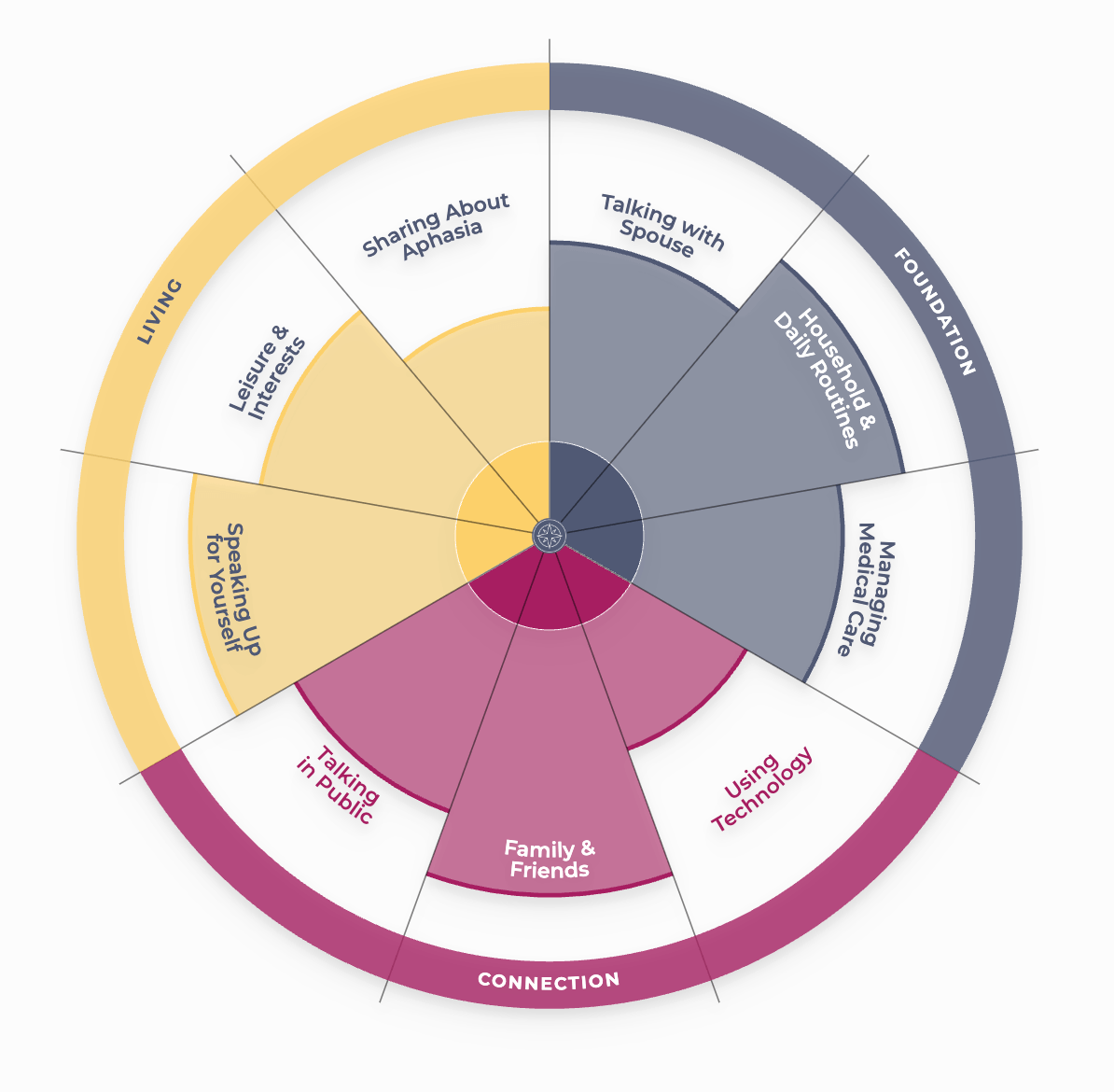
We ask you to do it with someone you trust: your spouse, a family member, a close friend. They will help you understand what the Compass is showing and be part of what comes next. For many couples it is the first time they have stopped and looked honestly at where things actually stand.
That picture is worth having. It is the first step into the Rebuilder Experience, the program we built specifically for this phase of recovery.
You have spent enough time wondering what comes next. This is where you find out.
Complete The Aphasia Strengths Compass now. I review every result personally.
Warmly,
Genevieve
P.S. Kevin told me he hesitated before reaching out. The system that was supposed to build him back up had let him down, and he wasn’t sure he could afford to get his hopes up again. He reached out anyway, and it changed everything. I hope you do, too.
LIFE Speech Pathology | Genevieve Richardson | LIFESpeechPathology.com



Download Now!